
horse breath, a somatic bio-hack for labour
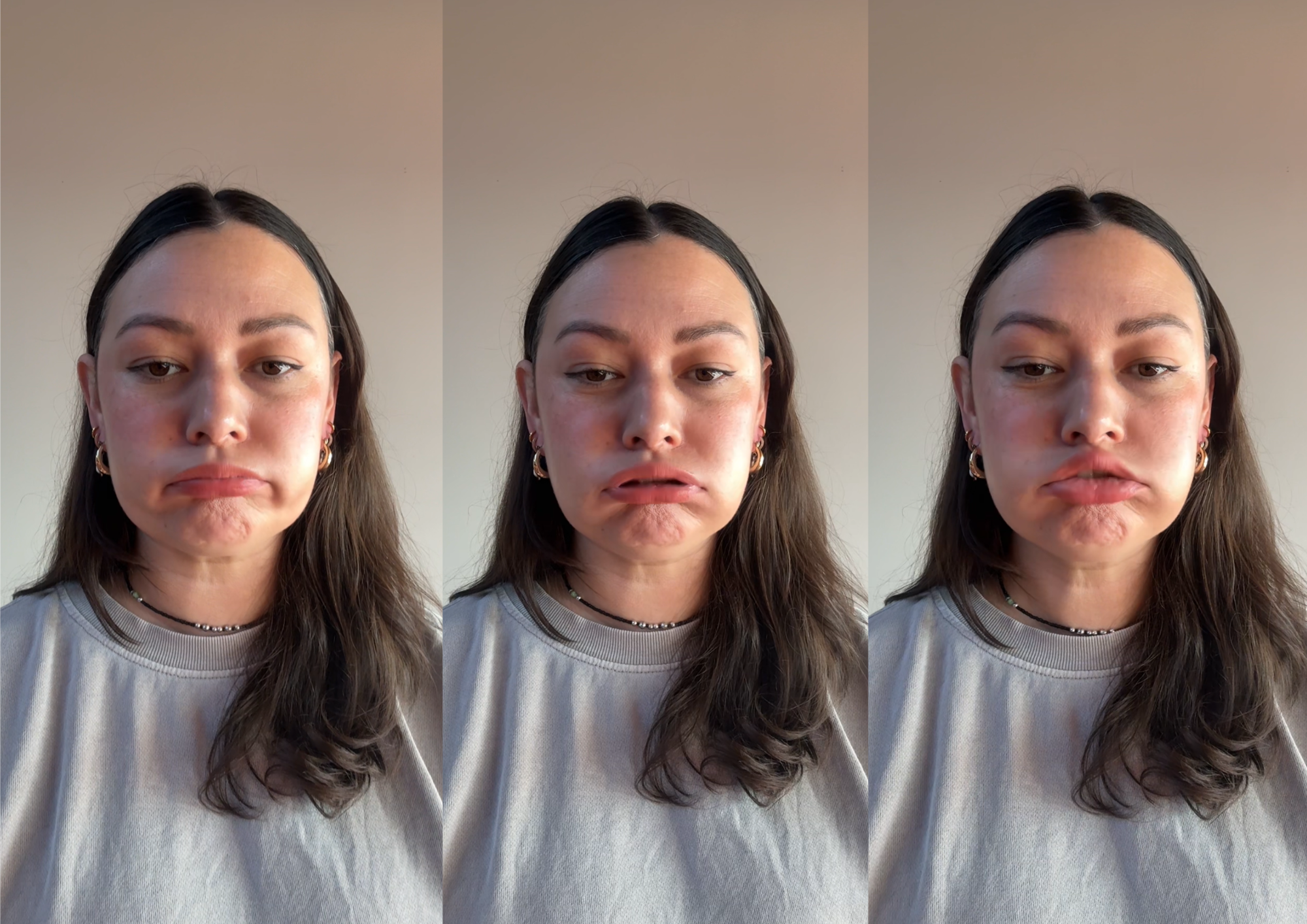
you can see the live video of my very own horse breath on instagram
Horse breath, also called horses breath, horse lips or raspberry breath. This is probably not the first time that you’ve heard a doula or midwife utter the words "horse breath" but perhaps this is the first time you’ve had it explained to you with enough of the why behind it to make it make sense.
Actually, before we jump in, I would love to hear any additional names you have for it!?
In short, horse breath is a brilliant physiological tool for labour, to support the process itself and how it feels for the birthing person.
It is a loose, vibrating exhalation through relaxed, slightly parted lips and it produces the fluttering, "brrrr" sound.
Soft lips here (points to face) mean soft lips here (points to the vulva); floppy face, floppy fanny; I believe that was a ‘naked doula’ phrase.
Anyway, the key to this breath working as intended is that that the lips, jaw, cheeks, and throat must all be soft to make the sound work.
But I wanted to deep dive a little on why it is SO effective. But I want to take a wide human-historic view first.
The open mouth, soft jaw, extended exhale, and vocalisation that are characteristic of horse breath, all appear independently across cultures and traditions as labour tools. Yep, this ain’t a new thing. This is embodied wisdom that predates the science by centuries.
This includes, but is likely not limited to, This includes pranayama traditions, which is yogic breathwork; Sama Vritti and Nadi Shodhana both work with exhale ratios; Ujjayi produces sound through a softly constricted throat; and Bhramari, the humming bee breath, uses a long vibrating exhale that activates exactly the same trigeminal and vagal pathways we'll get to shortly.
Many indigenous and traditional birth cultures use low, open-mouthed vocalisation in life and during labour, humming, moaning, toning, chanting. As a doula supporting birth I have witnessed, unprompted and without preparation, sounds shift from a higher register in early labour to become deep and low as it progresses; thought to ease the body’s work.
Okay, we can zoom in now.
There’s an anatomical connection. The jaw and the pelvic floor share embryological and fascial origins, they develop from the same tissue in utero and remain connected through the body's deep fascial network. When the jaw is clenched or held tight, tension travels down through the fascial chain, through the throat, thorax, diaphragm, and into the pelvic floor.
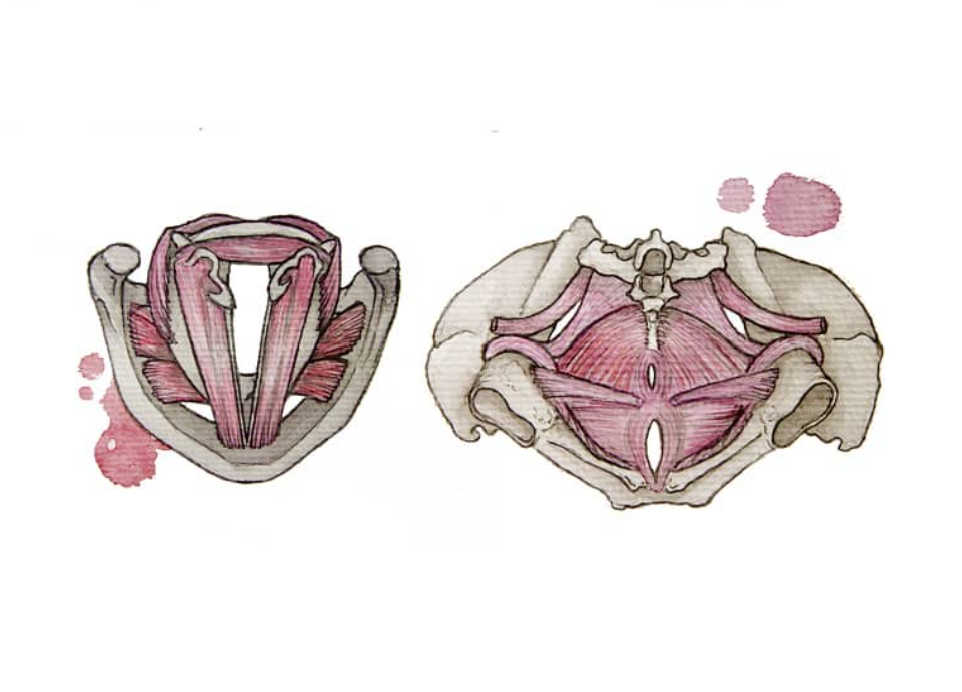
Visually the jaw and throat spaces share so much similarity to the pelvic space. Image source: https://www.instagram.com/luisaalexandre/
A soft jaw actively releases the pelvic floor. The cervix sits within the pelvic floor complex, so cervical softening and dilation are physically assisted when the surrounding muscles are not in spasm.
The horse breath brings about jaw softness because mechanically you literally cannot make that floppy lip sound with a clenched jaw.
When we are talking about softening we’re talking about so much more than lips. In the act of horses breath you are trying to influence a range of body parts either actively or as a byproduct of an action.
Lip (orbicularis oris) and cheek (buccinator) muscles must be completely soft and this proprioceptively signals softness upward and downward through the body. The muscles engaged when we clench (masseter and temporalis) need to disengage. Deep in our jaw (pterygoids) need to release, our tongue must drop from the roof of the mouth. Our throat and upper airway need to let go of that tension too and so the floor of our mouth (geniohyoid and mylohyoid) are also soft in the act of horses breath. Your diaphragm moves into a fuller, lower pattern of movement as the breath deepens. The levator ani and coccygeus, muscles of the pelvic space both release reflexively in response.
Horses breath activates a top-down myofascial release in real time with every exhale.
There is also a nervous system connection.
As we move through labour, intensity tends to increase, and often that means our experience of pain is amplified. This has the potential to activate our sympathetic nervous system, that "fight or flight" state which can really mess with the bodily processes of birth. You may have heard of the “fear > tension > pain” cycle? Well, we aren’t going to go into the fear aspect right now, but the tension = pain part, that is totally relevant here.
When our body activates in response to internal or external stimuli from a place of protection, our muscles can brace and guard, adrenaline can surge, our blood vessels can constrict (and we have vessels in our uterus!) and yep, that can also increase our perception of pain.
Horse breath counters the above cycle in several ways, signalling safety and allowing us to drop back into that rest and digest mode. It does this through:
A longer exhale activates the vagus nerve, whereas a short sharp exhale (like a gasp or pant) can actually increase sympathetic arousal.
Slow, audible breathing gives your thinking brain something steady to focus on and when it's busy with that, it turns the volume down on pain.
Vibrating your lips sends a constant gentle signal directly into your brain's fear centre, essentially telling it this is not an emergency. And when your brain believes that, your body follows.
Making sound, even just that soft brr, activates calming pathways in your throat, whereas holding your breath or going silent can keep your nervous system stuck in threat mode.
It’s about the breathing pattern too, in horse breath, the exhalation is longer than the inhalation; almost double. This 1:2 ratio is key to vagal activation. The horse breath makes this pattern almost automatic because you need a decent breath in to produce a sustained breath out.
Horse breath also has a flow on effect to our hormones.
Labour and birth is a hormonally driven process.
When we are feeling safe, calm and supported:
our body produces less adrenaline, which is a good thing, because peaks in the wrong moment can slow or stall labour
oxytocin flows more freely, enabling contractions, analgesic effects and bonding
our body makes more endorphins
stress hormone (cortisol) is kept at levels that work in ways that support both labouring person and baby
Tools like horse breath help us in a way that being told to relax often can’t. Sometimes we can’t think our way into relaxation, and honestly, sometimes being told to “relax” can make you feel a tad mad. So mid-contraction, when you can’t tell your pelvic floor to “relax”, you can definitely give horse breath a go.
It’s a sweet little somatic bio-hack that bypasses conscious control and works directly through the body's structural and neural wiring.
How to do horse breath
Relax your face, allow your tongue to drop from the roof of your mouth, slightly part you’re your lips, shake your head side to side, stop.
The key is soft. Soft lips, soft cheeks, soft jaw. Let your face be almost expressionless, slack, rather than held.
Breathe in through your nose, try not to raise your shoulders, a comfortable full breath.
Then, with your lips loosely together but not pressed shut, let the breath out through your mouth so that your lips flutter and vibrate. That's the brrrr sound. Think of a horse flapping its lips, or a child making a motorboat sound.
If the sound comes out tight or controlled, your jaw is probably still bracing. See if you can let the lower jaw hang just a little heavier.
The exhale should be longer than the inhale. Take your time with it, let it run out fully before you breathe in again.
It can feel silly at first. That's fine. Silly means loose, and loose is exactly what we're going for. Practice everyday, your body learns tools through repetition.
A few things to try:
Try it with sound, and then with more sound; a low hum or moan combined with the flutter amplifies the effect
Your support person can do it with you, which helps enormously, mirroring is a powerful regulator
If you lose it mid-contraction, your support person doing it near you can bring you back without a word being needed

Resources
Netter, F.H. Atlas of Human Anatomy (Netter's Atlas of Human Anatomy)
Van der Kolk, B. The Body Keeps the Score: Brain, Mind, and Body in the Healing of Trauma
Porges, S. The Polyvagal Theory: Neurophysiological Foundations of Emotions, Attachment, Communication, and Self-Regulation
Training Workbook CES Training Program
Multiple authors Radiant Birth Book One (Prayanama piece) Buy it here.
Glossary
Physiological — relating to how the body functions naturally; a physiological tool is one that works with the body's own processes rather than overriding them.
Pranayama — a system of breathwork from the yogic tradition; the word roughly translates as "extension of the life force" through breath. It encompasses many techniques, each with specific ratios, rhythms, and effects on the nervous system.
Sama Vritti — a pranayama technique meaning "equal movement"; the inhale and exhale are the same length. Used for balance and nervous system regulation.
Nadi Shodhana — alternate nostril breathing; a pranayama technique that works with breath ratio and is associated with balancing the nervous system.
Ujjayi — a yogic breath technique involving a slightly constricted throat that produces a soft oceanic sound on the exhale; activates vagal pathways through both sound and extended exhale.
Bhramari — the humming bee breath; a pranayama technique involving a long humming exhale that creates vibration in the lips, face, and throat. Activates the trigeminal nerve and vagal pathways — the same mechanisms at work in horse breath.
Toning — the sustained vocalisation of sounds or notes, used across many traditions for nervous system regulation, pain relief, and emotional release.
Register (vocal) — the pitch range of vocalisation. Lower registers involve more relaxed, open musculature in the throat and jaw, which is why the instinctive shift to lower sounds in labour is physiologically significant.
Embryological origins — referring to how structures develop in the embryo. When two parts of the body share embryological origins, they grew from the same tissue in the earliest stages of development.
Fascial network / fascia — fascia is the connective tissue that wraps around and connects every muscle, organ, and structure in the body. It forms a continuous web from head to toe, which is why tension in one area can travel to another.
Fascial chain — the pathway through which tension travels through connected fascial tissue. Think of it like a pull on one end of a piece of cling wrap affecting the whole sheet.
Pelvic floor — a hammock-like group of muscles that sits at the base of the pelvis, supporting the uterus, bladder, and bowel. In labour, these muscles need to be able to soften and release to allow the baby to move through.
Cervix — the lower part of the uterus that opens (dilates) during labour to allow the baby to pass through. It sits within the pelvic floor complex.
Proprioception / proprioceptively — the body's internal sense of its own position and movement. When one part of the body softens, proprioceptive signals communicate that information to surrounding and connected structures.
Orbicularis oris — the circular muscle around the mouth that controls lip movement and closure.
Buccinator — the muscle in the cheek wall, responsible for compressing the cheeks. It must be soft and released in horse breath.
Masseter and temporalis — the primary jaw-clenching muscles. The masseter runs along the jaw; the temporalis runs up the side of the skull. Both engage when we bite down or brace.
Pterygoids — a pair of deep jaw muscles (medial and lateral) that control chewing and jaw movement. They hold a lot of tension, especially under stress.
Geniohyoid and mylohyoid — muscles in the floor of the mouth, running between the chin and the hyoid bone in the throat. When these release, the throat and airway open and soften.
Diaphragm — the large dome-shaped muscle beneath the lungs that drives breathing. In a relaxed state it moves fully and deeply; under stress or breath-holding it can become shallow and tight.
Levator ani and coccygeus — the two main muscle groups that make up the pelvic floor. They support the pelvic organs and play a key role in birth.
Myofascial release — the releasing of tension held in both muscle (myo) and fascia together. A top-down myofascial release means this release begins at the head and jaw and travels downward through the body.
Sympathetic nervous system — one branch of the autonomic (automatic) nervous system, responsible for the "fight or flight" response. It increases heart rate, tightens muscles, and redirects blood flow away from non-essential functions — including, potentially, the uterus.
Parasympathetic nervous system — the other branch of the autonomic nervous system, responsible for "rest and digest." This is the state in which labour tends to progress most effectively.
Autonomic nervous system — the part of the nervous system that operates automatically, without conscious control. It regulates heart rate, digestion, breathing, and stress response.
Vagus nerve — the longest cranial nerve in the body, running from the brainstem through the throat, heart, lungs, and digestive system. It is the main pathway of the parasympathetic nervous system and is activated by slow, deep, extended exhalation and by sound vibration in the throat.
Vagal activation — stimulation of the vagus nerve, which shifts the body toward a calmer, parasympathetic state.
Sympathetic arousal — the activation of the fight or flight response; a state of heightened alertness and physical tension.
Prefrontal cortex — the front part of the brain responsible for thinking, decision-making, and focus. When it has something steady to attend to (like a slow audible breath), it is less available to amplify pain signals.
Trigeminal nerve — the largest cranial nerve, responsible for sensation across most of the face, including the lips, cheeks, jaw, and forehead. Vibration of the lips stimulates this nerve directly.
Limbic system / limbic brain — the part of the brain that processes emotion, fear, and threat. It can amplify pain perception and trigger the stress response. Gentle, rhythmic stimulation via the trigeminal nerve can have a calming effect on it.
Adrenaline (epinephrine) — a stress hormone released during fight or flight activation. In labour, a surge of adrenaline at the wrong time can slow or stall contractions by competing with oxytocin.
Oxytocin — often called the "love hormone," oxytocin drives uterine contractions, has natural pain-relieving properties, and supports bonding. It flows most freely in a calm, safe, supported environment.
Endorphins — the body's natural painkillers, produced in response to sustained rhythmic activity and a calm nervous system state.
Cortisol — the body's primary stress hormone. Some cortisol is normal and helpful in labour; chronically elevated levels can interfere with the hormonal processes that drive birth.
1:2 ratio — in breathwork, this refers to an exhalation that is twice the length of the inhalation. This ratio is associated with vagal activation and parasympathetic dominance.
Somatic — relating to the body, as distinct from the mind. A somatic tool is one that works through physical sensation and body-based experience rather than thought or cognition.
Bio-hack — an informal term for a simple, accessible technique that produces a significant physiological effect by working with the body's existing systems.
Note: I have learned the information to write this piece this through watching, reading, learning from many others in lived, learning and professional contexts, to numerable to name. The intent of my writing is not to claim an idea as my own but rather to share an idea with my own lens. If you feel your name should be here, let me know xo
Read more about Josie in the doula decks
